
An irrigation management system that finds the leak before your bill does.
Most commercial irrigation runs blind. A controller on a fixed schedule, watering overnight, unattended, with nobody watching the flow. When something fails, it keeps running — and you find out weeks later, from the bill.
An IMS closes that gap. The system learns what normal looks like for every zone, so a stuck valve or a broken lateral is an anomaly we see the day it starts — not a number you can't explain at month end.
Proactive isn't a service philosophy. It's a data problem. You cannot act on what you cannot see.
A clock can't see a leak. Measurement can.
Something fails. It keeps running.
A stuck valve doesn't announce itself. The system waters on schedule, at night, and the fault runs until something makes it visible — the landscaper mentions it, a zone browns off, or the bill arrives. Every litre in between is water you've already paid for and can't get back.
Something fails. We see it that day.
The system learns each zone's normal flow signature. A break, a stuck valve or a cracked lateral changes it — and the anomaly surfaces immediately. Most are diagnosed remotely, and many are corrected before anyone at the property knows there was a problem.
The day it happens, not the month it bills
Continuous flow monitoring against a learned baseline. At Toronto's 2026 commercial rate a 25 L/min leak costs about $175 a day — so the difference between finding it today and finding it on a 45-day billing cycle is roughly $175 against $7,875.
Weather decides, not a timer
Evapotranspiration data — temperature, humidity, wind, solar radiation — sets how much water to replace. On a cool wet week the system waters less, without anyone driving to site. This is where the routine savings come from; the leak detection is where the expensive ones do.
Stop watering the whole site for its thirstiest corner
A shaded courtyard and a south-facing parking island don't need the same water. Zones run independently.
Most faults are fixed without a truck
Schedules, run times and controller faults are handled remotely. You hear about it from us — not from a tenant, and not from the utility.
Your water use, on a dashboard
Irrigation water use, live, with the analytics to tell you whether it's normal for the site and the season. Most property managers have never seen this number, because no irrigation contractor produces it.
Both sides of the meter, one screen
The same dashboard carries your indoor water use. Irrigation and building water in one view — the only place you can see what the property actually spends in total.
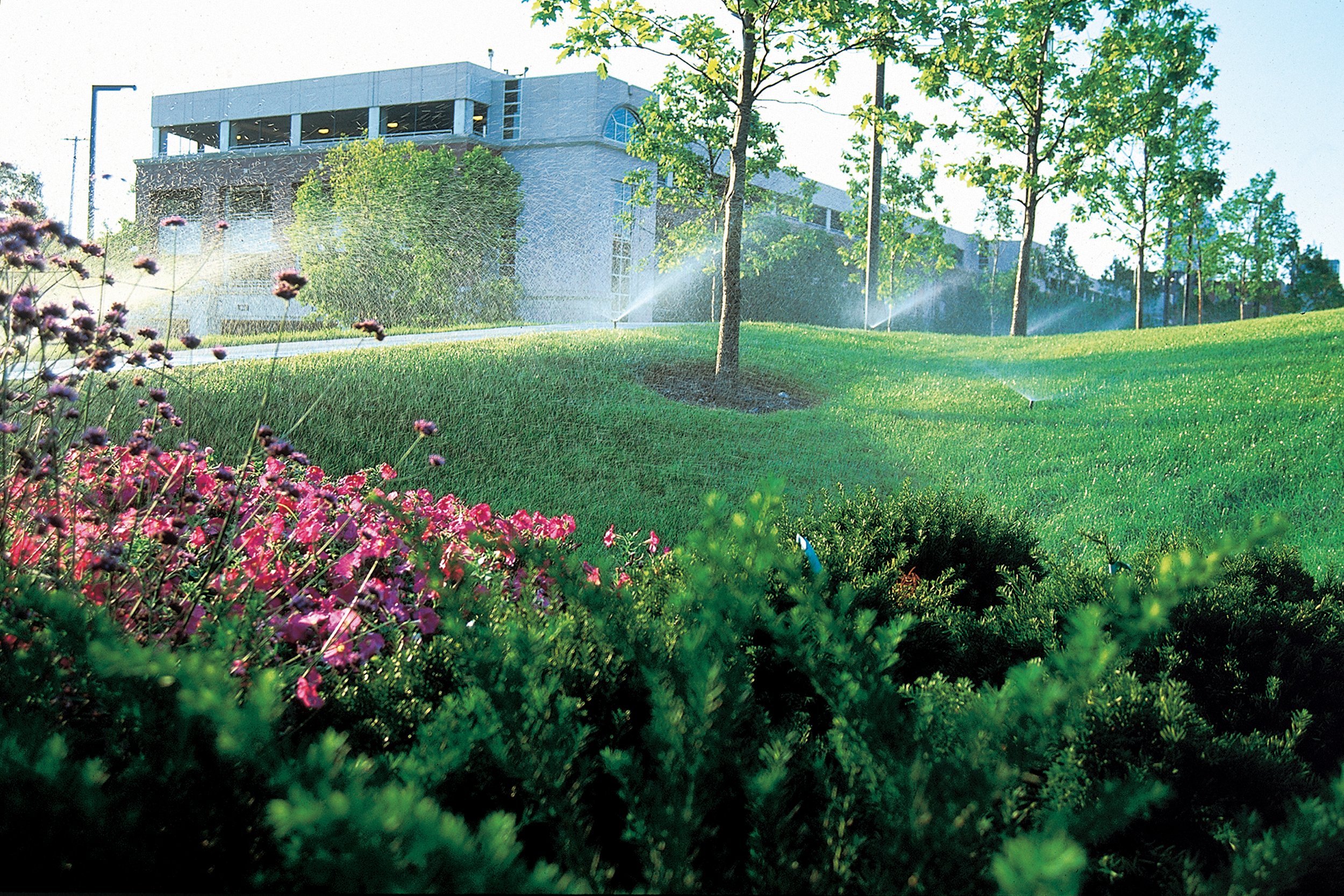
What an irrigation management system does and doesn't do.
What is an irrigation management system?
An irrigation management system replaces blind, fixed-clock irrigation with continuous measurement and data-driven control. It monitors flow on every zone so faults are detected the day they happen, uses evapotranspiration data to set how much water the landscape actually needs, controls each zone independently, and reports your water use on a dashboard. The distinction that matters is between a controller — which is hardware — and a managed service, in which a team is watching the data and acting on it.
What makes it proactive rather than reactive?
An unmonitored irrigation system gives you three ways to discover a fault: the landscaper mentions it, someone notices a dry patch, or the water bill arrives. All three happen weeks after the water started leaving. Under IMS, a stuck valve or broken lateral changes the zone's flow signature and surfaces as an anomaly immediately. This isn't a difference in attitude — it's a difference in information. A contractor with no flow monitoring cannot find a fault before you do, because they have no way to know.
How much water can it save?
EPA's guidance for commercial and institutional facilities states that improving irrigation efficiency could save a property more than half of its outdoor water use. Better scheduling produces the routine savings. Finding leaks early produces the large ones: at Toronto's 2026 commercial rate, a 25 litre-per-minute leak costs roughly $175 per day, so catching it on day one rather than on a 45-day billing cycle is the difference between about $175 and about $7,875. Across the 750+ properties we manage, we save over 200 million litres a year.
Is this just a smart controller?
No, and the difference is the whole point. A smart controller is hardware — it still needs someone to program it, watch it, respond to its alerts, and act when a zone fails. Most controllers we find on commercial sites are running schedules nobody has adjusted in years. An irrigation management system is a managed service; the hardware is the smallest part of it.
Can we see our water use data?
Yes — this is the part most property managers have never had. Your irrigation water use is reported on a dashboard, with analytics that tell you whether what you're seeing is normal for the site and the season. The same dashboard carries your indoor water use, so you can see the property's total water in one place. No sprinkler contractor produces this, and a leak-detection vendor can only show you the indoor half.
Do you need to replace our existing system?
Usually not. Most commercial sites can be brought under management by upgrading the controller and adding flow sensing, keeping the existing pipe and heads. Where zones are genuinely wasteful — spray heads on narrow beds, for instance — we'll recommend a targeted retrofit and show you the payback. We'd rather manage what you have well than sell you a system you don't need.
Both sides of the meter, one team.
Irrigation management (IMS)
ET-based scheduling, flow monitoring and monthly Water Intelligence Reporting.
Learn moreMaintenance & repair
Start-up, in-season service, emergency repair and winterization by in-house crews.
Learn moreInstallation & retrofit
New commercial systems, and retrofits that pay for themselves out of the water bill.
Learn moreIrrigation design
CID-certified design for new builds, retrofits, green roofs and amenity terraces.
Learn moreIndoor water management
Commercial leak detection with automatic shutoff — the other side of the meter.
Learn moreTell us about your property.
A site visit and written quote are free across our service area. A coordinator will get back to you the same business day to confirm scope and schedule the visit.
Connect with Us
For active repairs, urgent failures, or properties needing fast turnaround — calling is the fastest way to get on the schedule.