
Commercial irrigation maintenance before it becomes a repair.
Most commercial irrigation service is reactive. Something fails, and you find out when the landscaper mentions it, when someone notices a dry patch, or when the water bill arrives.
By then the water is gone. You've already paid for it, and you can't get it back.
We monitor the systems we maintain — so a fault is a flow anomaly on a dashboard, not a line on your utility bill.
The water is gone before anyone tells you.
There are only three ways an unmonitored property finds out its irrigation has failed. All three happen after the fact — and every litre in between is water you have already paid for.
The landscaper mentions it
Someone walking the site notices standing water or a head throwing wrong, and passes it along. Not their job, not their priority, and not their bill.
Somebody notices poor coverage
A zone browns off. But turf takes weeks to show stress — so by the time the damage is visible, the fault has been running the whole time.
The water bill arrives
The most common way commercial properties discover an irrigation leak. Billing cycles run 30 to 60 days. The water is long gone, and it is non-recoverable.
Toronto 2026 commercial water + wastewater rate: $4.8629/m³. A 25 L/min leak runs 36 m³ per day.
Four seasons, four different failures.
Scheduled service catches what's predictable. Monitoring catches everything else — which is most of it.
Start-up & commissioning
Charging the system, zone-by-zone testing, head alignmen, and system performance analysis. This is where winter damage surfaces — and where an unmonitored system quietly starts leaking for the season.
In-season
Peak demand, peak failure. Broken heads, stuck valves, controller faults. On a monitored site these show up as flow anomalies in days. On an unmonitored one, they show up on the August bill.
Winterization
Blow-out and shutdown. Done badly, this is what cracks laterals and splits backflow assemblies — and you don't find out until spring start-up, when it all surfaces at once.
Emergency repair
Main breaks and failures that can't wait. Our own crews, dispatched from Milton — so the team that saw it in the data is the team that fixes it.
Two scheduled visits a year cannot catch a valve that sticks in July. Only measurement can. That's why we monitor the systems we maintain — and why proactive service costs less than reactive service, not more.
Six services. Everything irrigation, under one team.
From the first spring start-up to the last winterization blow-out, we self-perform every irrigation service a commercial property needs — by our own certified field crews, with documentation after every visit. No subcontractors. No handoffs. No finger-pointing.
Spring Start-Up
Bring your irrigation system back online for the season — safely, methodically, and with documentation. We pressurize the system, walk every zone, replace what didn't survive the winter, and re-program the controller for current conditions.
- Zone-by-zone pressure check
- Head & nozzle inspection / replacement
- Controller re-programming for spring conditions
Mid-Season Inspection
The mid-summer tune-up most contractors skip. We catch broken heads, drifted spray patterns, and clock drift before they cost a full season's worth of overwatering. The single highest-ROI service in the calendar.
- Run every zone, observe coverage and uniformity
- Adjust spray patterns & head heights
- Recalibrate controller for peak-season weather
- Flag any issues before they become breakdowns
Winterization
The most important service of the year in Ontario. A missed line costs five figures in spring repairs. We blow out every line with industrial compressed air, drain the backflow, and document the shutdown — site by site, zone by zone.
- Industrial compressor blow-out of every line
- Controller shut-down & documentation
- Written winterization certificate per property
Service + Repairs
Broken heads, mainline leaks, stuck valves, failed solenoids, wiring problems. We diagnose, dig, repair, and restore — all by our own field team. Same-day or next-day response for most issues across the GTA & Golden Horseshoe.
- Mainline & lateral leak repair
- Valve & solenoid replacement
- Controller & wiring troubleshooting
- Sod & landscape restoration after digs
Retrofitting
Bring an aging system up to current standards. We upgrade legacy controllers to Wi-Fi or cellular smart units, swap inefficient spray heads for high-efficiency nozzles, and convert planting beds to sub-surface drip. Typically pays back in one to two seasons.
- Smart controller upgrades (Hunter Hydrawise, Rain Bird IQ)
- MP rotator & high-efficiency nozzle conversion
- Drip irrigation conversion for planting beds
- Zone consolidation & system rebuild
Installation
For new builds, major renovations, or properties without an existing system — full irrigation design and turnkey installation. AutoCAD drawings, hydraulic calculations, fixture specifications, and certified install by our own crew, coordinated with your landscape architect.
- AutoCAD-based design drawings
- Hydraulic calculations & pressure mapping
- Spec packages ready for tender
- Turnkey install, commissioning & warranty
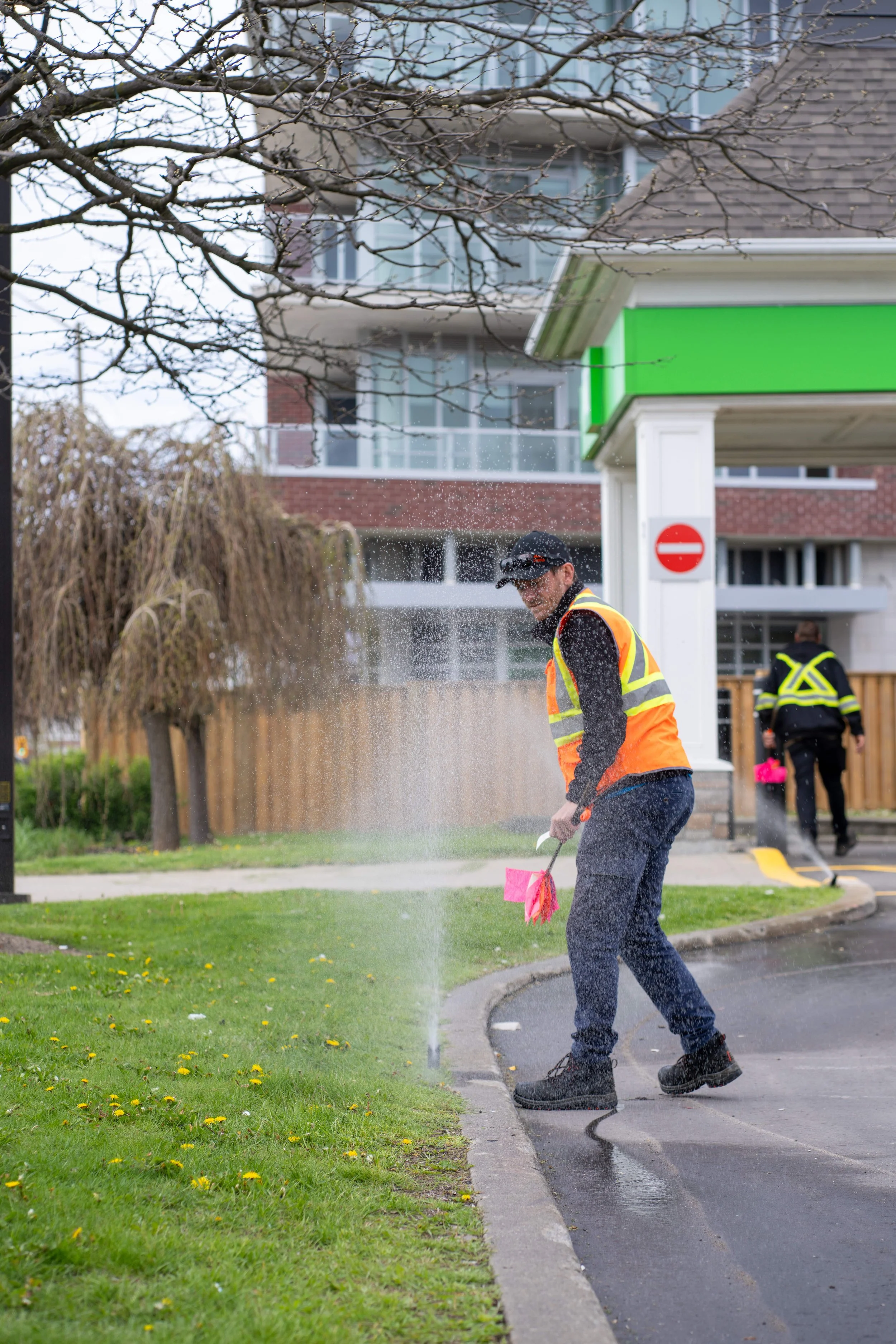
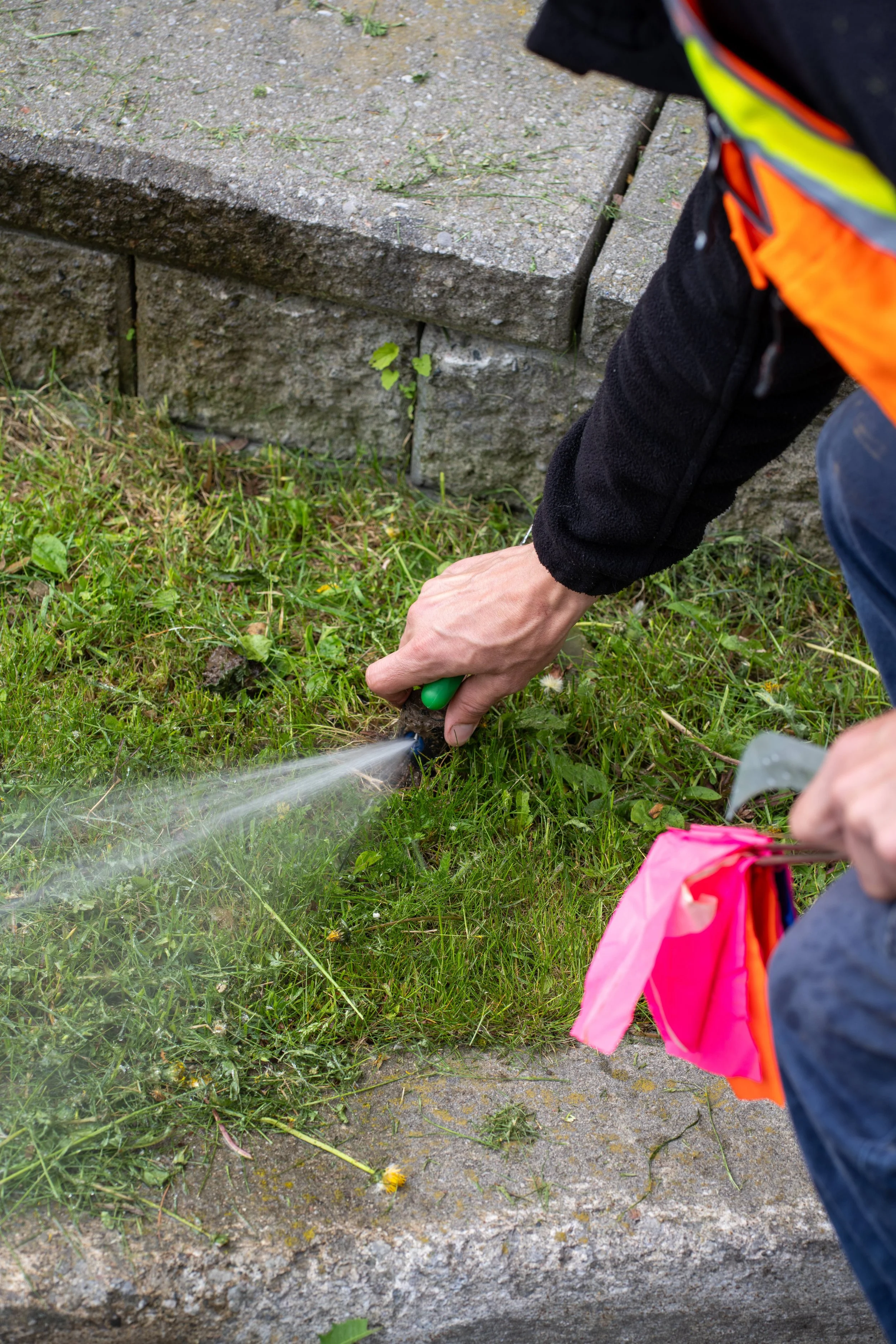
Why property managers pick SMART over other irrigation contractors.
There are hundreds of irrigation contractors across the GTA and Golden Horseshoe. We're not the cheapest, and we don't pretend to be. Here's what we offer that most of the others don't.
750+ commercial properties under active service.
Most regional irrigation contractors operate at 50–150 commercial accounts. We're at 750+. That difference shows up in scheduling reliability, parts inventory, technician coverage, and the institutional knowledge of how Ontario commercial irrigation actually breaks.
CIT-certified technicians, on staff. No subcontractors.
Every technician on a property is on our payroll, CIT (Certified Irrigation Technician) credentialed, and trained internally. We don't sub work out to whoever's available — the same team installs, services, and stands behind the work.
Ontario — one accountable team.
Most regional contractors cover one sub-region. We service the entire Golden Horseshoe under a single operations team. Whether your portfolio is Mississauga, Milton, Hamilton, or St. Catharines, you call one number.
Advanced Control Systems — Specialists.
Most contractors are loyal to one manufacturer because of margin or training.
Service reports, not just invoices.
Every visit produces documentation — zones tested, parts replaced, runtime configured, issues flagged, and our expert recommendations. Photos where it matters. The kind of paper trail your ownership and asset management teams actually want.
Twenty seasons and counting.
SMART Watering Systems was founded in 2007. Through every winter, every drought year, every spring with hundreds of properties demanding start-up the same week. That kind of operational maturity is hard for a newer contractor to match.
Twelve credentials. Behind every service call.
Both sides of the meter, one team.
Irrigation management (IMS)
ET-based scheduling, flow monitoring and monthly Water Intelligence Reporting.
Learn moreMaintenance & repair
Start-up, in-season service, emergency repair and winterization by in-house crews.
Learn moreInstallation & retrofit
New commercial systems, and retrofits that pay for themselves out of the water bill.
Learn moreIndoor water management
Commercial leak detection with automatic shutoff — the other side of the meter.
Learn moreCommercial irrigation maintenance — what to expect.
What does commercial irrigation maintenance include?
At minimum: spring start-up and commissioning, in-season inspection and repair, and autumn winterization. On a monitored contract it also includes continuous flow monitoring, schedule adjustment through the season, and your water use reported on a dashboard. The difference between the two is not the number of visits — it is whether a fault is found the day it starts or the month the bill arrives.
What does 'proactive' actually mean here?
It means we find the problem before you do. On a monitored site, a stuck valve or broken lateral changes the zone's flow signature, and we see it immediately. On an unmonitored site there are only three ways to discover the same fault: the landscaper mentions it, someone notices a dry patch, or the water bill arrives — and all three happen weeks after the water started leaving. This isn't a service philosophy. It's a data problem: a contractor with no flow monitoring cannot find a fault before you do, because they have no way to know.
Isn't scheduled maintenance enough?
Scheduled maintenance catches what's predictable — winter damage at start-up, freeze risk at winterization. It cannot catch a valve that sticks in July, three weeks after your last visit. Most commercial irrigation failures happen between visits, and on an unmonitored system they run until something makes them visible. Measurement is what closes that gap.
How much does an irrigation leak actually cost?
At Toronto's 2026 commercial water and wastewater rate of $4.8629 per cubic metre, a 25 litre-per-minute leak — a routine stuck-valve failure — runs about 36 cubic metres a day, or roughly $175 per day. Found by flow monitoring on the day it starts, that's about $175. Found when the bill arrives on a 45-day cycle, it's closer to $7,875. Same leak, same property; the only variable is whether anyone was watching.
Do you subcontract your work?
No — every technician who attends your property is our employee. It matters less as a promise than as a mechanism: because the same team runs every site, the flow data is consistent across your whole portfolio, and the people who see a fault in the data are the people who go and fix it. One company sees it and solves it, rather than one company reporting it to another.
Can you take over a system another contractor installed?
Yes, and it is a large part of what we do. We assess the system as it stands, tell you honestly what's working and what isn't, and bring it under monitoring. We would rather manage a competently built system than sell you a replacement you don't need.
Why does winterization matter so much?
Water left in a system freezes and expands. Done badly, winterization is what cracks laterals, splits backflow assemblies and destroys valves — and you typically don't discover any of it until spring start-up, when the system is charged and the damage surfaces all at once. Proper blow-out is one of the cheapest pieces of insurance on a commercial property.
Tell us about your property.
A site visit and written quote are free across our service area. A coordinator will get back to you the same business day to confirm scope and schedule the visit.
Connect with Us
For active repairs, urgent failures, or properties needing fast turnaround — calling is the fastest way to get on the schedule.